Walking is universally recognized as the foundation of human movement. However, modern exercise physiology reveals a critical limitation in conventional fitness advice: standard, low-intensity steady-state walking often fails to create the cardiovascular and muscular stimulus required to trigger significant physiological adaptation.
The Japanese walking method—known in medical literature as Interval Walking Training (IWT)—solves this problem directly. Developed through decades of clinical research in Japan, this protocol replaces arbitrary daily step goals with structured, intensity-varying intervals. It bridges the gap between casual strolling and high-impact training, offering an efficient, joint-friendly, and scientifically verified fitness system.
This comprehensive guide breaks down the core Japanese walking benefits, biomechanics, physiological mechanisms, gear requirements, and programming structures to help you get the most out of every session.
What is Japanese Walking?
The Japanese walking method is a structured, evidence-based conditioning protocol that alternates between high-intensity brisk walking and low-intensity recovery walking. Instead of focusing on accumulating thousands of leisurely steps over several hours, this protocol uses short, focused bursts of effort to elevate the heart rate, challenge skeletal muscle, and trigger vascular adaptations.
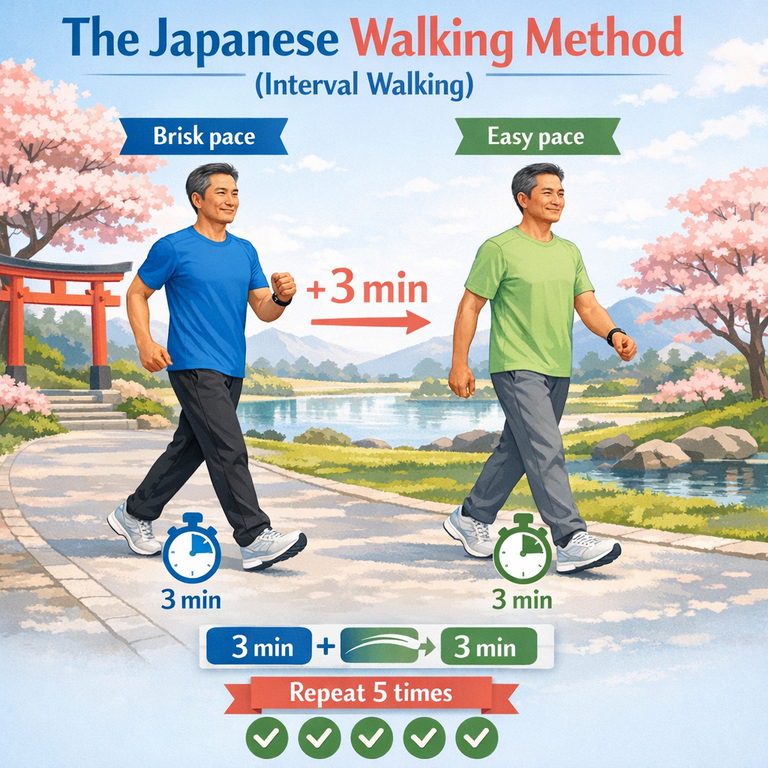
The entire system is built around a simple, repeatable 3:3 interval structure: three minutes of fast walking followed immediately by three minutes of slow, active recovery walking. Repeating this cycle five times creates a 30-minute workout that delivers far greater fitness gains than a continuous walk of the same duration.
History of Japanese Walking Techniques
The Japanese walking technique was developed by Dr. Hiroshi Nose, M.D., Ph.D., alongside Dr. Shizue Masuki and their research team at the Shinshu University Graduate School of Medicine in Matsumoto, Japan.
During the late 1990s and early 2000s, Nagano Prefecture faced an aging demographic and escalating healthcare costs linked to lifestyle-related conditions: hypertension, type 2 diabetes, osteoporosis, and sarcopenia (age-related muscle wasting). Dr. Nose sought an exercise intervention that met three conditions:
- Zero Financial or Equipment Barrier: It had to be accessible anywhere without gym memberships or specialized equipment.
- Minimal Orthopedic Stress: It had to protect aging or compromised joints from the high impact forces of running.
- Clinical Efficacy: It had to generate enough cardiovascular and metabolic intensity to create measurable, long-term health improvements.
The outcome was the Japanese walking exercise, formalised and validated through the multi-year Matsumoto Health Project. Over decades of clinical trials involving thousands of subjects, Dr. Nose demonstrated that alternating between brisk, purposeful walking and low-intensity recovery delivered physiological gains that continuous steady-state walking could not match.
The Foundational 3:3 Interval Formula
The core Japanese walking method relies on a clear, alternating rhythm:
- 3 Minutes of Fast Walking: Performed at 70% or greater of an individual’s peak aerobic capacity, corresponding to a Rate of Perceived Exertion (RPE) of 6 to 7 on a 10-point scale.
- 3 Minutes of Slow Walking: Performed at 40% or less of peak aerobic capacity (RPE 2 to 3 on a 10-point scale) for active recovery.
- Volume and Frequency: 5 full cycles per session (30 minutes of interval work), performed at least 4 days per week. This totals 120 minutes of weekly walking, containing exactly 60 minutes of high-intensity aerobic stimulus.
How Does Japanese Walking Improve Health? (The Physiological Mechanisms)
To understand how does Japanese walking improve health, we must look at what happens inside the body during interval training. Continuous walking keeps the body in a metabolic steady state. The Japanese walking exercise disrupts this steady state, forcing the cardiorespiratory and muscular systems through repeated cycles of stress and recovery.
1. Cardiorespiratory Conditioning and Aerobic Expansion
Aerobic fitness is governed by peak oxygen consumption—the maximum volume of oxygen the body can transport and use during exercise.
During the 3-minute fast interval:
- Stroke volume (the volume of blood ejected by the left ventricle per beat) peaks.
- Arterial walls experience increased fluid shear stress, triggering the endothelial release of nitric oxide, which widens vessels and restores vascular elasticity.
- The heart muscle undergoes a healthy physiological load, strengthening the myocardium.
During the 3-minute slow interval, peripheral resistance drops, allowing the heart to pump against lower resistance while clearing metabolic byproducts. Shinshu University studies confirmed that older adults practicing this method improved their peak aerobic capacity by 9% to 14% over five months. In contrast, control groups walking at a continuous, self-selected moderate pace showed no significant change in peak aerobic capacity.
2. Muscle Fiber Recruitment and Hypertrophy
Casual walking relies almost entirely on fatigue-resistant, slow-twitch (Type I) muscle fibers. While essential for endurance, Type I fibers produce low mechanical force and have limited capacity for strength gains.
Pushing walking speed to your maximum cadence changes this dynamic:
- The nervous system recruits higher-threshold, fast-twitch (Type IIa) muscle fibers.
- The quadriceps, hamstrings, gluteus medius, and calf muscles fire forcefully to stabilize joints and generate horizontal propulsion.
- Research shows an average increase of 13% to 17% in knee extension and flexion strength, providing a protective barrier against sarcopenia.
3. Glucose Transport and Insulin Sensitivity
During high-intensity intervals, rapid muscle contractions deplete intracellular glycogen stores and increase the cellular energy demand. This activates AMP-activated protein kinase (AMPK), triggering the movement of Glucose Transporter Type 4 (GLUT4) storage vesicles to skeletal muscle cell membranes.
This process clears glucose from the bloodstream independently of insulin, significantly improving glycemic control for individuals with insulin resistance, prediabetes, or type 2 diabetes.
4. Anti-Inflammatory Signaling via Myokines
Chronic low-grade inflammation accelerates cardiovascular disease, neurodegeneration, and metabolic decline. When skeletal muscle contracts at higher intensities, it acts as an endocrine organ, releasing signaling proteins called myokines—specifically Interleukin-6 (IL-6).
Unlike macrophage-derived IL-6, which promotes inflammation, exercise-induced muscle-derived IL-6 acts as a powerful anti-inflammatory agent:
- It stimulates anti-inflammatory cytokines like Interleukin-10 and Interleukin-1 receptor antagonist.
- It inhibits tumor necrosis factor-alpha, a primary driver of vascular inflammation and insulin resistance.
Japanese Walking vs. Western Walking
For decades, Western fitness messaging has focused on the target of 10,000 steps per day. While tracking total movement is helpful for reducing sedentary time, step volume alone ignores the critical biological variable of intensity.
In a traditional Western walking approach:
- The primary focus is cumulative step volume.
- Sessions require 60 to 90 minutes daily, totaling 7 to 10 hours per week.
- The intensity remains low and constant, maintaining baseline fitness without triggering significant cardiovascular or muscular gains.
- Caloric burn returns to baseline immediately after the walk ends.
In the Japanese walking method:
- The primary focus is structured intensity variation.
- Sessions require 30 minutes, 4 days per week, totaling just 2 hours weekly.
- Alternating speeds forces the heart and muscles to adapt, boosting aerobic capacity by 10% to 14% and lower-body strength by 13% to 17%.
- The high-intensity intervals trigger an afterburn effect that keeps energy expenditure elevated for hours post-session.
To achieve comparable cardiovascular gains through continuous moderate walking, you would need to walk briskly for over an hour every day. The Japanese approach achieves superior cardiovascular, muscular, and metabolic adaptations in a fraction of the time.
Comprehensive Health Benefits of Japanese Walking
The health benefits of Japanese walking extend across multiple organ systems, offering full-body conditioning with minimal orthopedic strain.
Japanese Walking and Cardiovascular Health
Cardiovascular disease remains the leading cause of mortality worldwide. The Japanese walking method targets several primary markers of cardiovascular dysfunction:
- Blood Pressure Reduction: By enhancing endothelial nitric oxide production and lowering resting sympathetic tone, this exercise routine reduces systolic blood pressure by an average of 9 mmHg and diastolic pressure by 5 mmHg in hypertensive adults.
- Arterial Elasticity: The recurring pulses of higher blood flow soften central arterial stiffness, reducing pulse wave velocity and shielding sensitive organs like the brain, kidneys, and heart from excessive pulsatile stress.
- Autonomic Balance: Alternating between fast and slow intervals trains the baroreceptor reflex, improving the body’s ability to switch smoothly between sympathetic effort and parasympathetic recovery.
Japanese Walking for Weight Loss & Fat Metabolism
When using Japanese walking for weight loss, the metabolic advantages extend far beyond the workout itself:
- Excess Post-Exercise Oxygen Consumption (EPOC): The high-intensity intervals disrupt cellular homeostasis. Returning the body to its resting state—restoring energy reserves, processing lactate, and cooling core temperature—requires elevated oxygen and energy consumption for hours afterward.
- Visceral Fat Mobilization: Visceral fat (the metabolically active fat surrounding inner abdominal organs) has a high density of beta-adrenergic receptors. The adrenaline surges triggered by fast intervals accelerate fat breakdown in these deeper abdominal stores.
- Preserving Lean Tissue: Unlike restrictive dieting paired with high-volume cardio, which often causes muscle loss, this method builds and preserves lower-body muscle mass, protecting your baseline resting metabolic rate.
Japanese Walking for Joint Pain Relief
High-impact activities like running create ground reaction forces of 2.5 to 3 times your body weight with every stride. For individuals with osteoarthritis or excess body weight, this impact can cause inflammation and wear on cartilage.
- Low-Impact, High Muscular Stimulus: Fast walking increases muscular work while keeping ground reaction forces low (roughly 1.1 to 1.3 times body weight).
- Synovial Fluid Circulation: The alternating cycle of loading and unloading acts as an internal pump, circulating synovial fluid through the hip, knee, and ankle joints. This delivers oxygen and nutrients to non-vascularized articular cartilage while clearing waste products.
- Dynamic Joint Stabilization: Strengthening the quadriceps, hamstrings, and calves through interval walking helps stabilize the knee, reducing painful shearing forces across the joints. This makes Japanese walking for joint pain relief an exceptionally safe and effective strategy.
Japanese Walking for Posture Correction
Prolonged sitting causes a common pattern of postural imbalances: shortened hip flexors, weak gluteal muscles, forward head posture, and rounded shoulders. Practicing japanese walking for posture correction systematically reverses these issues:
- Glute Activation and Hip Extension: Pushing off forcefully during fast intervals requires full hip extension, waking up underused gluteal muscles and stretching tight hip flexor muscles.
- Core Stabilization: Staying tall while moving quickly engages the deep core musculature to keep the pelvis level and stable.
- Upper-Body Realignment: Driving the arms back with elbows bent at 90 degrees pulls the shoulder blades back and down, strengthening the upper back muscles while opening the chest.
Japanese Walking for Mindfulness and Stress Reduction
Beyond its physical benefits, the structured intervals make japanese walking for mindfulness an effective mental reset:
- Active Somatosensory Awareness: Checking your pace, form, and breathing every three minutes keeps you anchored in the present physical moment, breaking cycles of mental fatigue and rumination.
- BDNF Production: Reaching higher aerobic intensities stimulates the release of Brain-Derived Neurotrophic Factor in the hippocampus, supporting learning, memory, and cognitive resilience.
- Balancing Stress Hormones: The higher-intensity intervals help clear circulating cortisol and adrenaline, while the recovery phases promote parasympathetic calm and mental clarity.
Unlocking Japanese Longevity Secrets
Japan consistently ranks among the highest nations for life expectancy, with regions like Nagano standing out for healthspan—the number of years lived free of chronic disability. The science behind Japanese walking benefits for health reflects the core principles of Japanese longevity secrets: longevity is built not on extreme, sporadic workouts, but on consistent, lifetime-accessible physical activity that preserves functional strength, joint mobility, and cardiovascular health well into older age.
Biomechanics and Japanese Walking Posture Mastery
Maintaining correct japanese walking posture ensures optimal power output with minimal joint stress. Every part of your kinetic chain plays a distinct role during the workout.
Head, Gaze, and Cervical Spine
Maintain a neutral cervical spine stacked directly over the ribcage. Direct your gaze 15 to 20 meters ahead on the ground. Never look straight down at your feet or phone. Tilting the head downward shifts your center of mass forward, overloading the cervical spine and encouraging a rounded, hunched upper back. Keep your chin parallel to the ground throughout the session.
Shoulder Retraction and 90-Degree Arm Swing
Your upper body provides the rhythm and momentum for your stride. Bend your elbows to a strict 90-degree angle. The arm swing must originate entirely from the shoulder joints, not the elbows. Drive your elbows backward with intent. This backward drive naturally recruits the upper back and counters the forward momentum of your legs, preventing rotational twisting in the lower back. Keep your hands relaxed in loose fists without clenching.
Pelvic Positioning and Core Bracing
Keep the pelvis neutral to protect the lower back and maximize glute activation. Maintain a light 15% to 20% brace through your abdominal wall, as if preparing for a gentle tap. Avoid excessive arching in the lower back or tucking the tailbone under. A neutral pelvis gives the hip flexors and extensors full, uninhibited range of motion.
Heel Strike, Midfoot Roll, and Big-Toe Drive
Your foot strike dictates how force is transmitted up through your body:
- Heel Strike: Land softly on the outer rear edge of your heel. Do not overstride by reaching the foot far out in front of your body, which acts as a brake and strains the knees.
- Midstance: Roll smoothly along the lateral edge of the foot toward the forefoot as your body passes over the leg.
- Push-Off: Drive forcefully off the ground through the ball of your foot, finishing through the big toe while squeezing the glute of the trailing leg.
During fast intervals, keep your head level, lock your arms at 90 degrees with an energetic backward drive, brace your core, and push off forcefully. During slow intervals, allow your arms to swing loosely at your sides, soften your foot strike, and let your breathing settle naturally.
Step-by-Step Japanese Walking Technique: The Complete Protocol
Here is the exact step-by-step Japanese walking technique to structure your workouts for maximum benefit.
Phase 1: Dynamic Warm-Up (5 Minutes)
A brief warm-up prepares your joints, tendons, and cardiovascular system for higher-intensity work:
- Easy Walking (2 Minutes): Walk at a casual, relaxed pace to warm up cold muscles and stimulate blood flow.
- Ankle Mobility Rotations (30 Seconds per side): Perform slow ankle circles in both directions to lubricate the joint for smooth heel-to-toe rolls.
- Dynamic Leg Swings (1 Minute): Swing each leg forward and backward 10 to 12 times to open up the hips and dynamic range in the hamstrings.
- Torso Rotations & Shoulder Rolls (1 Minute): Rotate your torso gently from side to side and roll your shoulders backward to prepare for active arm swinging.
Phase 2: The Interval Core (30 Minutes)
1. The Fast Interval (3 Minutes)
- Intensity Target: 70% or greater of Peak Aerobic Capacity or Heart Rate Reserve.
- The Talk Test: Speaking full sentences should feel difficult; you should be able to speak only in short, clipped phrases.
- Perceived Exertion: RPE 6 to 7 out of 10 (Somewhat Hard to Hard).
- Technique Cues: Lock elbows at 90 degrees, drive arms back, engage the core, push off through the big toe, and increase stride turnover.
2. The Slow Recovery Interval (3 Minutes)
- Intensity Target: 40% or less of Peak Aerobic Capacity.
- The Talk Test: You can easily speak in complete sentences and breathe comfortably through your nose.
- Perceived Exertion: RPE 2 to 3 out of 10 (Light to Very Light).
- Technique Cues: Drop your arms to a natural, relaxed swing, shorten your stride to a normal walking pace, and take deep diaphragmatic breaths to lower your heart rate.
3. Cycle Repetitions
Repeat this alternating sequence 5 times without stopping. Five cycles of 6 minutes (3 fast plus 3 slow) equals exactly 30 minutes of interval work.
Phase 3: Targeted Cool-Down (5 Minutes)
- Gradual Deceleration Walk (2 Minutes): Stroll slowly to allow heart rate and blood pressure to return toward resting levels safely without blood pooling in the lower legs.
- Standing Calf Stretch (60 Seconds per leg): Step one leg back, press the heel into the floor, and lean gently forward with a straight back leg.
- Standing Hip Flexor Stretch (60 Seconds per leg): Step into a small lunge, gently tuck the pelvis under, and shift your weight forward until you feel a light stretch along the front of the rear hip.
How to Start Japanese Walking at Home and Indoors
You do not need access to outdoor paths or running tracks to practice the Japanese walking exercise. You can easily adapt the protocol for home use, treadmills, or bad-weather days.
Standard Treadmill Setup
On a standard treadmill, set your fast interval speed between 5.8 and 7.0 km/h (3.6 to 4.3 mph) with an incline of 1.0% to 2.0% to mimic outdoor wind resistance and ground push-off. For the slow interval, drop the speed to 3.5 to 4.5 km/h (2.2 to 2.8 mph) at a flat 0.0% to 0.5% incline. Focus on driving your elbows back and breathing deeply.
Incline Treadmill Setup
If you prefer lower speeds to reduce joint stress further, you can use an incline trainer. Set your fast interval speed to 4.8 to 5.5 km/h (3.0 to 3.4 mph) with a steeper incline of 4.0% to 6.0%. This dramatically raises the cardiovascular intensity without requiring fast foot turnover. For the recovery interval, lower the speed to 3.2 to 4.0 km/h (2.0 to 2.5 mph) and reduce the incline to 0.0% to 1.0%.
Small Space and Hallway Adaptations
If you do not own a treadmill, you can practice indoors by pacing brisk laps through an open hallway or living area. Alternatively, you can perform high-cadence stationary marching with high knees and a forceful 90-degree arm drive during the fast intervals, followed by a gentle, casual stroll around the room during the recovery phases.
Key Rules for Indoor Walking
- Set a 1% Baseline Incline: Setting a motorized treadmill deck to a 1.0% to 1.5% incline matches the energy cost of walking outdoors on flat ground.
- Keep Hands Off the Rails: Holding onto treadmill handrails reduces your energy expenditure by up to 25%, prevents core activation, and disrupts spinal rotation. If you need the handrails to maintain balance, reduce the speed until you can walk comfortably with free arm movement.
- Use Built-In Interval Timers: Save custom interval presets into your treadmill console so it automatically adjusts speeds every 3 minutes, freeing you from manual button pressing.
Best Shoes for Japanese Walking Method & Gear Setup
Because the Japanese walking technique requires a forceful push-off, high cadence, and active heel-to-toe rolling, your footwear needs to support these dynamic mechanics.
Essential Features in a Walking Shoe
- Moderate Heel-to-Toe Drop (4mm to 8mm): Many traditional running shoes feature a steep 10mm to 12mm+ drop, which can limit ankle dorsiflexion and promote overstriding. A moderate 4mm to 8mm drop allows for a natural foot roll and full calf engagement.
- Forefoot Flexibility: Stiff or carbon-plated shoes prevent the metatarsal joints from bending during the push-off phase. Look for the best shoes for japanese walking method that bend easily across the ball of the foot.
- Moderate, Stable Cushioning: Avoid overly soft, ultra-thick foam soles. Excessive cushioning can create instability during rapid walking, forcing ankle stabilizers to work overtime.
- Firm Heel Counter: A structured heel cup keeps the heel bone locked in place, preventing slipping and friction blisters during fast intervals.
Recommended Footwear Categories
- Performance Walking Shoes: Shoes specifically engineered with flexible forefoot grooves and stable heel cups, such as the Brooks Addiction Walker or New Balance 847 series.
- Lightweight Daily Running Trainers: Neutral, moderate-stack road running shoes like the Brooks Ghost, Saucony Ride, Hoka Clifton, or Altra Torin for wider, zero-drop foot shapes.
Helpful Accessories
- Interval Timer or Smartwatch: Use a vibrating smartwatch (Apple Watch, Garmin, Fitbit) or a standalone interval timer to signal interval transitions without needing to check a screen.
- Breathable Athletic Socks: Choose synthetic or merino wool blends with reinforced heels and seamless toes to eliminate friction hot spots.
Demographic Adaptations: Seniors, Beginners, and Athletes
The Japanese walking method is adaptable across the entire fitness spectrum, from frail individuals to conditioned endurance athletes.
Is Japanese Walking Good for Seniors?
Is Japanese walking good for seniors? The original clinical research at Shinshu University was conducted primarily on older adults aged 60 to 80. The findings demonstrated clear, life-changing improvements:
- Fall Prevention: Strengthening the quadriceps, hamstrings, and ankle dorsiflexor muscles significantly improves balance, dynamic stability, and gait speed, reducing trip-and-fall incidents.
- Bone Mineral Density Support: The dynamic mechanical loading during the fast intervals creates healthy stress on the femoral neck and lumbar spine, stimulating bone-building cells to help counter osteopenia and osteoporosis.
- Safe Cardiovascular Stress: Because brisk walking increases heart rate without the heavy joint impacts of jogging, seniors can achieve target training heart zones with minimal orthopedic risk.
Senior Safety Tips:
- Walk on smooth, predictable surfaces such as paved park paths, school tracks, or a well-maintained treadmill.
- If balance is a concern, consider using Nordic walking poles to provide four stable points of ground contact during the fast intervals.
The Beginner Progression Plan
If 3 consecutive minutes of fast walking feels too demanding at first, use this gradual ramp-up schedule:
- Weeks 1 to 2: 1 minute Fast / 3 minutes Slow (Repeat 5 times = 20 minutes total).
- Weeks 3 to 4: 2 minutes Fast / 3 minutes Slow (Repeat 5 times = 25 minutes total).
- Week 5 onwards: Standard 3 minutes Fast / 3 minutes Slow (Repeat 5 times = 30 minutes total).
Advanced Athlete Modifications
Conditioned athletes can use the protocol for low-impact conditioning, active recovery, and aerobic base maintenance:
- Incline Walking: Perform the fast intervals up a 4% to 8% outdoor hill or steep treadmill incline.
- Weighted Vests: Wear a vest weighing 5% to 10% of your body weight. Avoid hand or ankle weights, which alter natural joint mechanics and strain tendons.
How to Practice Japanese Walking Daily: Schedules & Tracking
To experience the lasting health benefits of japanese walking, consistency over months and years is essential. Here is how to practice japanese walking daily with structured weekly programming and objective tracking.
Sample 4-Day Weekly Schedule
- Monday: 30-Minute Interval Session focusing on target cadence across a flat, smooth route.
- Tuesday: Active Rest Day with gentle stretching, joint mobility work, or an easy casual stroll.
- Wednesday: 30-Minute Interval Session focusing on incline treadmill walking or rolling outdoor terrain.
- Thursday: Full Rest Day for systemic recovery.
- Friday: 30-Minute Interval Session focusing on strict posture check, core bracing, and 90-degree arm drive.
- Saturday: 30-Minute Interval Session performed outdoors in a park or nature trail.
- Sunday: Full Rest Day.
12-Week Progressive Training Structure
- Base Phase (Weeks 1 to 3): 3 sessions per week, completing 4 interval cycles per session (24 minutes total). This provides 36 minutes of weekly high-intensity stimulus.
- Build Phase (Weeks 4 to 6): 4 sessions per week, completing the standard 5 interval cycles per session (30 minutes total). This provides 60 minutes of weekly high-intensity stimulus.
- Progress Phase (Weeks 7 to 9): 4 sessions per week, completing 5 interval cycles per session, introducing rolling hills or treadmill inclines during fast intervals.
- Peak Phase (Weeks 10 to 12): 5 sessions per week, completing 5 interval cycles per session (30 minutes total). This provides 75 minutes of weekly high-intensity stimulus.
Tracking Meaningful Progress
Instead of tracking only total step count, monitor these three physiological markers:
- Cadence (Steps per Minute): Aim for 80 to 95 steps per minute during the slow recovery interval, and 125 to 145+ steps per minute during the fast interval, depending on your height and leg length.
- Heart Rate Recovery: Track how quickly your heart rate drops during the 3-minute slow interval. As your cardiovascular conditioning improves, your heart rate will drop faster and more completely during active recovery.
- Session Rate of Perceived Exertion: Rate your overall effort from 1 to 10 after each workout. Over weeks of training, walking speeds that initially felt like an 8 out of 10 will feel like a 5 or 6 as your aerobic capacity expands.
Common Mistakes & Biomechanical Troubleshooting
Avoid these common technical errors to protect your joints and maximize the effectiveness of your training:
- Overstriding (Reaching the Front Foot Out): Landing with your foot far ahead of your center of mass creates a braking force that stresses the knees and shins. Focus on shortening your landing stride and driving forward off your trailing big toe instead.
- Looking Down at Your Feet: Dropping your head rounds the cervical spine, restricts airflow, and collapses the chest cavity. Keep your eyes fixed 15 to 20 meters ahead and balance your head directly over your shoulders.
- Straight-Arm Swinging: Letting your arms swing straight like pendulums lengthens the lever arm, slowing your cadence and fatiguing your shoulders. Keep your elbows locked at 90 degrees and drive them backward from the shoulder joint.
- Insufficient Speed Contrast: Walking at a similar speed during both fast and slow intervals fails to trigger the cardiovascular and metabolic adaptations of interval training. Use the talk test: fast segments must make speaking full sentences difficult.
- Abrupt Hard Stopping: Sitting down immediately after a fast interval causes blood pooling in the legs and post-workout lightheadedness. Always walk slowly for 2 to 3 minutes during your cool-down before resting.
Summary and Key Takeaways
The Japanese walking method is an evidence-backed alternative to both arbitrary step-counting and high-impact conditioning. By organizing walking into structured, high-effort intervals and active recovery phases, you trigger meaningful adaptations across your cardiovascular, metabolic, and musculoskeletal systems.
- The Core Formula: 3 minutes fast walking (70% or greater peak effort) alternated with 3 minutes slow walking (40% or less effort).
- The Target Volume: 5 complete cycles totaling 30 minutes per workout, practiced 4 days per week.
- The Proven Results: Clinically verified improvements in peak aerobic capacity, lower-body strength, blood pressure regulation, glycemic control, and joint mobility.
- The Posture Keys: Elbows locked at 90 degrees, shoulders retracted, gaze forward, neutral pelvis, and a forceful big-toe push-off.
With just two hours of focused effort per week, you can build the cardiovascular resilience, joint mobility, metabolic flexibility, and leg strength that form the cornerstone of Japanese longevity secrets. Set your timer, focus on your form, and turn your daily walk into a powerful tool for lasting health.