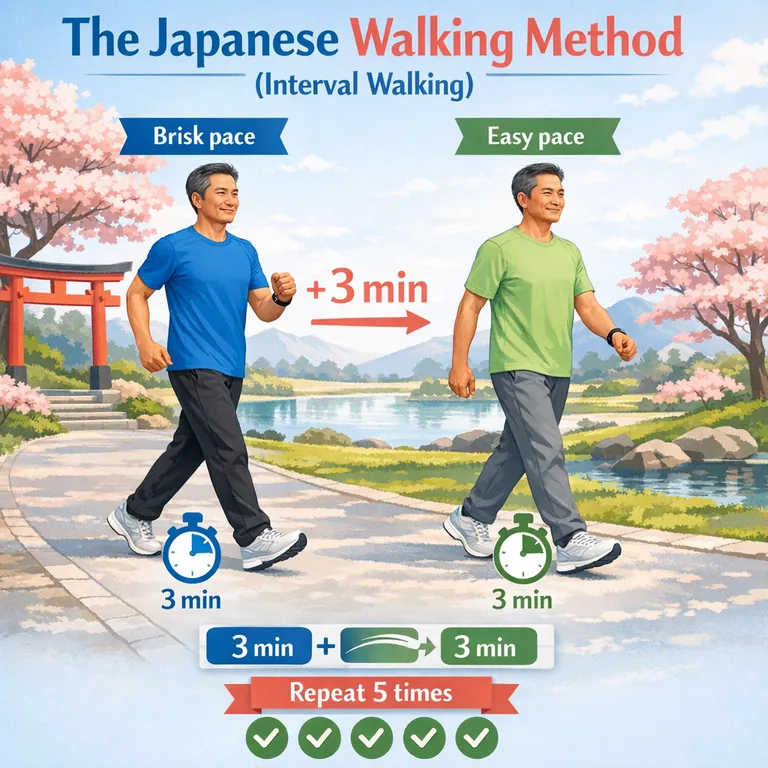
The Japanese walking method usually means interval walking: alternating an easier pace with a faster walking pace. It offers a simple way to vary a walk. The strongest claims on this page concern fitness, leg strength and blood pressure in a specific trial; it is not a proven shortcut to weight loss, pain relief or a longer life.
What the original trial actually found
A 2007 randomised trial by Nemoto and colleagues assigned 246 middle-aged and older adults, with a mean age of 63, to no walking training, continuous moderate walking or interval walking for five months. The interval prescription used at least five cycles of three minutes at lower intensity and three minutes at higher intensity, on at least four days a week. Intensity was monitored; this was more structured than an unmeasured stroll.
The researchers reported greater improvements in knee strength and peak aerobic capacity in the interval group than in the continuous-walking group, and a greater reduction in resting systolic blood pressure. Not all participants met the programme targets. These results describe a group studied over months, not a guaranteed response for an individual or a benefit after one session.
Where the evidence stops
That trial did not establish that this walking method causes muscle hypertrophy, reverses insulin resistance, treats joint pain or makes people live longer. It also does not show that every interval walk is better than every steady walk. Regular walking at a comfortable pace remains a useful option. Claims about fat loss, inflammation or “longevity secrets” need their own direct evidence.
Understand the three-minute pattern
Three minutes easy plus three minutes faster makes one six-minute cycle. Five cycles make 30 minutes of intervals. A warm-up and cool-down add time; they are not included in those 30 minutes. You do not need to start with the full research prescription or copy its measured intensity.
A gentler starting example
- Choose a familiar, level route and supportive shoes. Keep a phone or a walking companion available if appropriate.
- Begin with several minutes at an easy pace. You should feel steady and comfortable.
- If a quicker pace suits you, try one short brisk section, then return to an easy pace. Start with less than three minutes if needed.
- Keep the faster section as walking, with a natural stride. Do not force your arms, overstride or chase a wearable heart-rate number.
- Finish at an easy pace. Make a note of whether the pace and duration felt manageable during the walk and afterwards.
This starting example is an adaptation for readers, not a tested clinical programme. Repeat a comfortable version before increasing the length or the number of faster sections. Change one thing at a time. If intervals feel awkward, a steady easy walk is a reasonable choice.
Safety and individual advice
Ask a qualified clinician about exercise intensity if you have a heart or lung condition, unstable symptoms, recent surgery, a fall or a new balance problem. Stop for sharp or worsening pain, dizziness or unusual breathlessness. Chest pain, fainting or severe breathing difficulty require urgent medical attention. Do not change medicines or use walking to replace recommended treatment.
Fit walking into a balanced week
Walking is one part of a movement routine. The Healthy Ageing Exercise Guide also covers strength and balance, while Walking on Rest Days helps you choose a comfortable recovery walk. For general advice on beginning activity, see Healthdirect: Fitness and exercise.
Common questions
Do I need a special app? A basic timer is enough to organise intervals. A wearable can help with timing, but its estimates do not replace clinical guidance or the monitoring used in a study.
Will it lower my blood pressure by a set amount? No particular reduction is guaranteed. The original trial supports a possible benefit from a sustained programme, not a universal numerical promise.
Is it suitable for every older adult? Ability, symptoms, medication and balance vary. Choose a pace and duration that suit your circumstances, with professional help when needed.
Editorial update, 8 October 2026: This article was revised to remove unsupported mechanism, pain-relief and longevity claims, clarify the trial’s limits and distinguish the study protocol from a gentler starting example.
Edited by Ben Shannon. This is general educational information from a nonclinical publisher. It has not been medically reviewed. Read the editorial policy and health disclaimer.