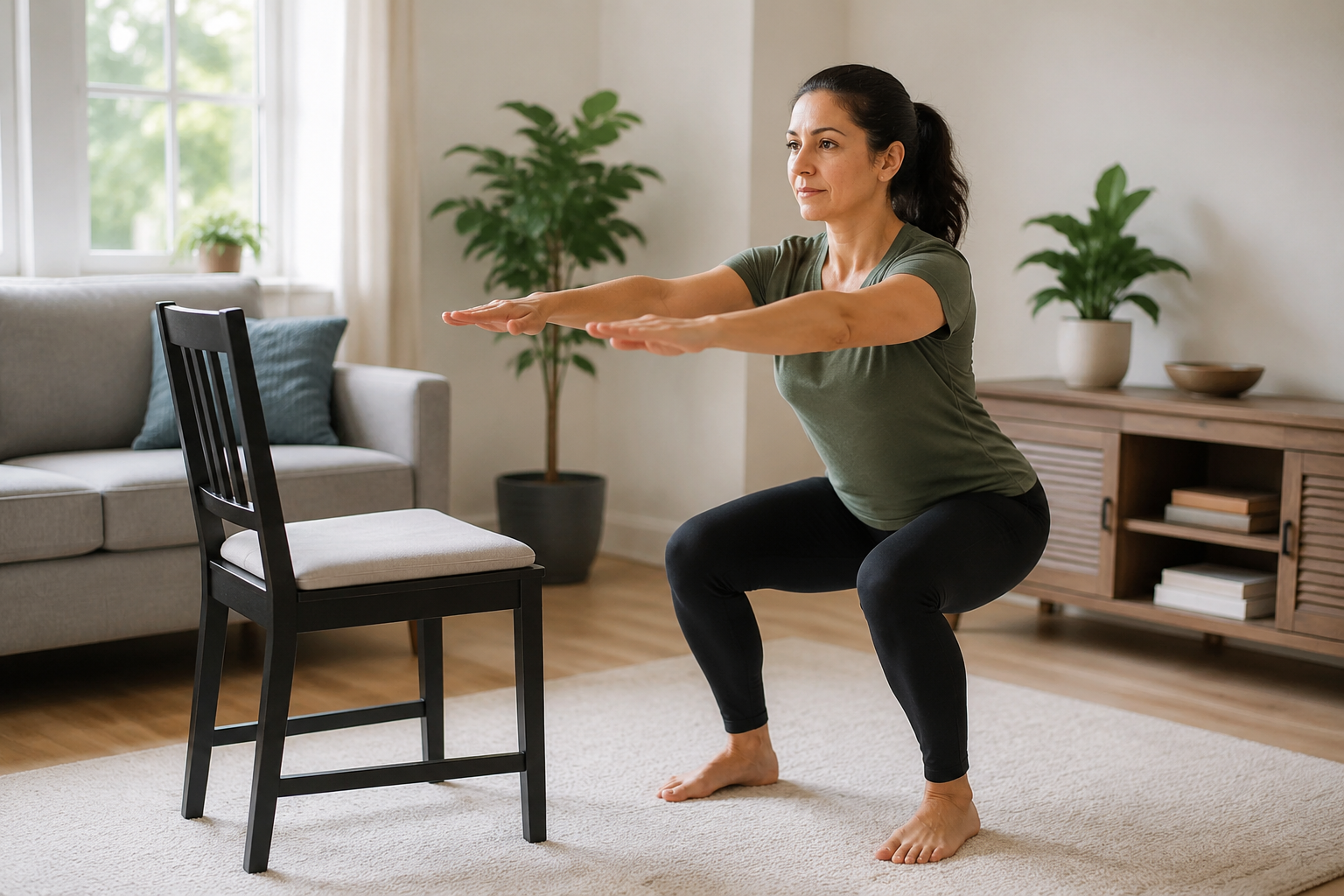
Functional fitness exercises prepare you for real movements rather than a single machine or mirror muscle. They help you sit and stand, hinge to pick something up, carry uneven loads, climb steps, push, pull, reach and move safely from the floor.
“Functional” does not have to mean unstable equipment or complicated circuits. The most useful beginner program usually trains simple patterns with enough control to transfer to daily life. The American College of Sports Medicine lists functional fitness among the top trends for 2026, describing it as training that enhances real-world movement and daily performance.
This guide covers eight everyday strength exercises and a beginner functional workout. Use pain-free ranges and stable supports. Seek individual advice if you have a recent injury, major balance difficulty, medical restrictions or symptoms that make exercise unsafe.
What makes an exercise functional?
An exercise is functional when it improves a capacity relevant to your goals. A chair squat is functional for someone who wants to rise from low seats. A suitcase carry is functional for shopping and luggage. A floor transfer is functional for gardening, play and getting up after a non-injurious fall.
Context matters. A barbell deadlift can be highly functional for a person who needs to lift, while a supported hip hinge may be more appropriate for a beginner. Complexity is not the test; useful transfer is.
Good functional training develops:
- strength through common patterns;
- balance and coordination;
- control across comfortable ranges;
- capacity to carry or sustain effort; and
- confidence performing daily tasks.
1. Sit-to-stand
Daily task: Rising from chairs, toilets, cars and low surfaces.
Sit toward the front of a stable chair with feet planted. Lean your trunk slightly forward, press through your feet and stand. Reach your hips back and lower with control.
Perform 6 to 12 repetitions.
Easier: Use a higher chair, cushions or your hands.
Harder: Hold a light backpack at your chest or pause just above the seat.
Avoid collapsing onto the chair. Smooth lowering is part of the exercise.
2. Hip hinge and object lift
Daily task: Picking up bags, laundry or objects from a low surface.
Stand with a light object close to your legs. Soften the knees, push your hips back and keep the object near you. Press the floor away and stand tall.
Begin by lifting from a table or chair seat rather than the floor. Perform 6 to 10 repetitions.
Key cue: Keep the load close. Reaching a weight far away increases the demand on your trunk.
Our beginner strength guide explains the hinge in more detail.
3. Step-up
Daily task: Stairs, kerbs and uneven paths.
Use the bottom stair with a handrail or a low, secure platform. Place the whole foot on the step, lean slightly forward and drive through that leg to rise. Step down carefully.
Perform 6 to 10 repetitions each side.
Easier: Use a lower step or more hand support.
Harder: Slow the lowering or hold a light load after the basic version is steady.
Do not use a chair, loose box or unstable object as a step.
4. Incline push-up
Daily task: Pushing a heavy door, trolley or object away.
Place hands on a wall or stable bench. Walk the feet back and keep the body in a comfortable straight line. Bend the elbows to bring your chest toward the surface, then press away.
Perform 6 to 12 repetitions.
The higher the surface, the easier the movement. Keep your shoulders away from your ears and move the ribs and pelvis together.
5. Supported row
Daily task: Pulling a door, moving an object closer or controlling a load.
Use a resistance band secured according to its instructions, or support one hand on a bench while rowing a light backpack with the other. Pull toward the side of your ribs and lower slowly.
Perform 8 to 12 repetitions each side.
Avoid shrugging or twisting. Choose resistance that lets the shoulder blade move smoothly.
6. Suitcase carry
Daily task: Carrying groceries, a work bag or luggage.
Hold a dumbbell, shopping bag or backpack at one side. Stand tall and walk slowly across a clear space. Keep your shoulders level and avoid leaning away from the load.
Carry for 20 to 40 seconds each side.
Easier: Stand still with the load.
Harder: Add a little weight or time—not both at once.
7. Half-kneeling or floor transfer
Daily task: Gardening, play, household tasks and getting up from the floor.
Practise beside a heavy chair or bench. From standing, step back into a supported split stance, lower one knee onto a cushion, bring the second knee down and reverse the sequence to rise.
Only practise if kneeling is comfortable and you can use the support securely. A physiotherapist can provide alternatives if knee pain, dizziness or balance makes this unsuitable.
Easier: Practise getting from a chair to a high kneeling pad or perform supported split squats without reaching the floor.
8. Reach, rotate and place
Daily task: Putting groceries away, reaching shelves and turning to move objects.
Hold a light object with both hands. From a stable stance, rotate through a comfortable range and place it on a surface beside you. Return, then repeat to the other side.
Perform 5 to 8 repetitions each direction.
Move through the feet, hips and upper back together rather than twisting sharply through one area. Begin between waist and chest height.
A 25-minute functional workout for beginners
Warm up for four minutes with easy marching, shoulder circles, hip hinges and five sit-to-stands.
Complete two rounds:
- Sit-to-stand: 8–12
- Hip hinge lift: 8–10
- Incline push-up: 6–12
- Supported row: 8–12 each side
- Step-up: 6–10 each side
- Suitcase carry: 20–30 seconds each side
- Reach and place: 6 each direction
Rest 30 to 90 seconds between movements as needed. The session is not a race. Stop each set while you can still perform two or three controlled repetitions.
Practise floor transfers separately when you are fresh and have safe support. Technical, balance-demanding skills do not belong at the exhausted end of a circuit.
How often should you train?
Two non-consecutive full-body sessions per week are a useful beginner target. Add aerobic activity, mobility and balance on other days. If two sessions cause prolonged soreness, begin with one session or one round and build gradually.
Repeat the core routine for four to six weeks. Familiarity makes it easier to notice progress and improve technique.
Progress functional exercises safely
When you reach the top of a repetition range with stable form and feel you could do three more, choose one progression:
- add one or two repetitions;
- add a small amount of weight;
- slow the lowering phase;
- increase the comfortable range;
- reduce hand support slightly; or
- add a second set.
Progress should preserve the movement quality that makes the exercise useful. A heavier lift that forces twisting may be less functional than a lighter, controlled one.
Train the task, then vary the context
Daily life is not perfectly symmetrical. After you learn the basic movements, introduce sensible variety:
- carry a different load in each hand;
- step up leading with either leg;
- place objects at several safe heights;
- walk while carrying; and
- practise on different firm surfaces.
Add one variation at a time. Do not combine heavy loads, unstable surfaces and fatigue simply because it looks advanced.
Mobility and balance still matter
Strength cannot express itself well if a task requires a range or level of control you do not have. Ankle mobility affects stairs and squats. Upper-back and shoulder mobility affect reaching. Balance affects stepping and carrying.
Combine this routine with the daily mobility routine and, when relevant, supported balance practice.
Common functional fitness mistakes
Making every exercise unstable
Standing on a wobble surface reduces how much force you can safely produce. Stable strength training and specific balance practice can be trained separately before combining them.
Copying tasks too literally
You do not have to lift an awkward laundry basket repeatedly to prepare for laundry. Build hinge, squat, carry and grip capacity with controllable equipment, then apply sensible lifting habits.
Ignoring the easier direction
Lowering onto a chair, stepping down and placing a load are important. Control the return phase instead of concentrating only on getting up or lifting.
Training through sharp pain
Muscle effort is expected; sharp, increasing or joint-specific pain is a reason to modify. Reduce load or range, use another variation or seek assessment.
Measure what matters
Useful signs of progress include:
- needing less hand support to stand;
- climbing stairs with less effort;
- carrying shopping without leaning;
- lifting a familiar object with more confidence;
- getting to and from the floor more smoothly; and
- completing daily tasks with less fatigue.
Gym numbers can be motivating, but daily capacity is the purpose of functional fitness.
The bottom line
Functional fitness exercises do not need to be flashy. Train the patterns that daily life asks for: squat, hinge, step, push, pull, carry, transfer and reach. Use stable setups, repeat the basics and add challenge gradually.
The best functional workout is one that makes life outside the workout feel a little easier.
Further reading
Continue with these guides
- Beginner Fitness Guide
- Healthy Habits Guide
- Resistance Band Workout: Full-Body Beginner Routine
- Healthy Snacks for Work: 20 Ideas That Travel Well
A note on this post: I’m Ben Shannon, the person behind Healthful Harbor. I’m not a doctor, dietitian, physiotherapist, psychologist or any other kind of clinician. I’m a regular person who reads research, tries things, and writes about what’s worked for me. Everything on this site is general educational information, not individual medical, nutrition or mental-health advice. For your own situation, please talk with a qualified professional who knows your circumstances. See the Health Information Disclaimer for the full picture.