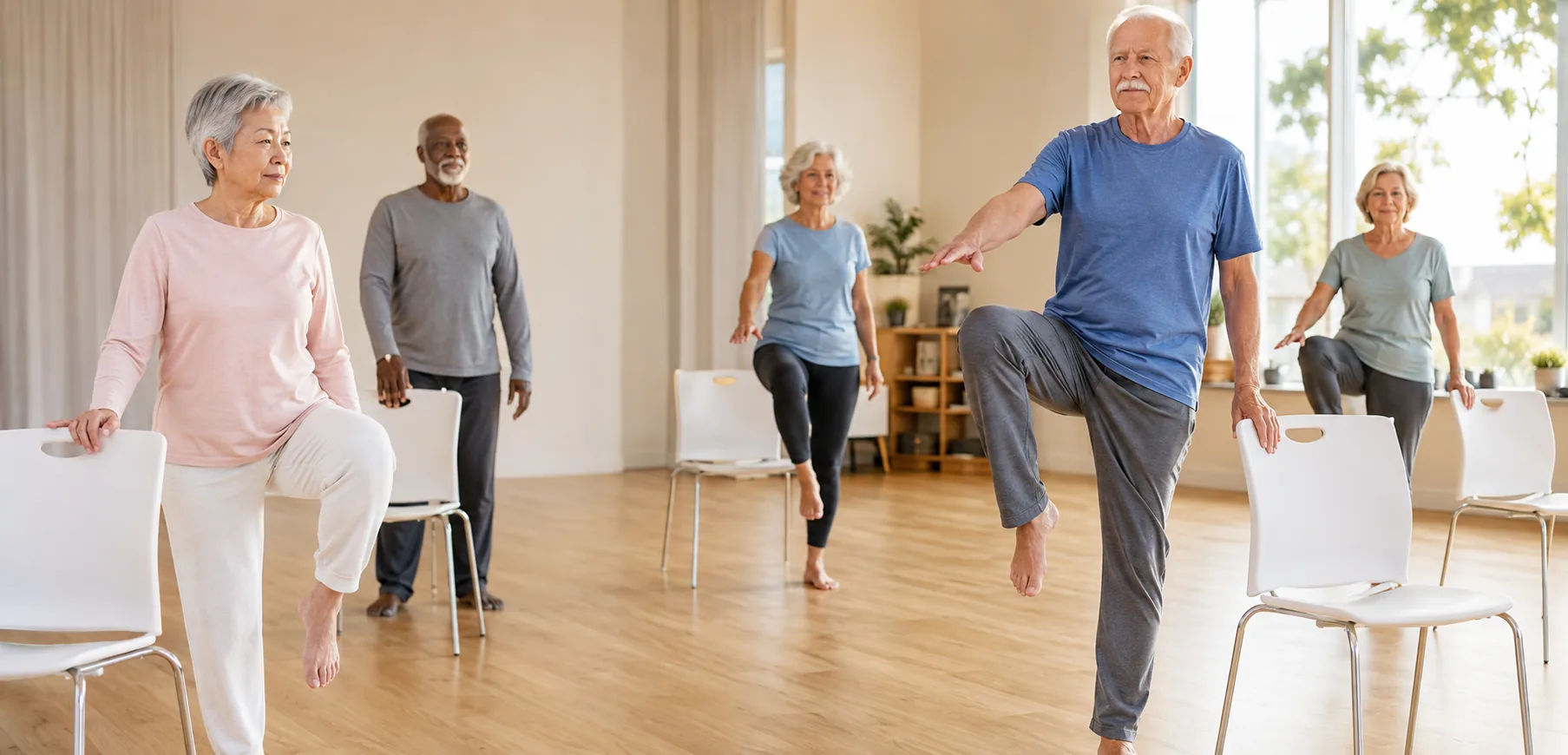
Balance exercises for seniors can improve control, confidence and the ability to respond when the body moves unexpectedly. Balance is not a single trait you either have or lack. It draws on vision, the inner ear, sensation, strength, reaction time, attention and practice.
The safest program starts below the point of panic. Use a stable kitchen bench or heavy chair, clear the floor and choose a level that creates mild challenge without putting you at risk of falling. If you have had recent falls, dizziness, new numbness, sudden weakness or a condition that affects balance, seek individual assessment before progressing alone.
This routine includes 12 senior stability exercises from supported standing to stepping and reaching. You do not need to perform all of them. Choose four to six and practise for about ten minutes, three to five days a week.
Set up a safe balance practice area
Before starting:
- Place a stable support within easy reach.
- Avoid wheeled chairs, lightweight furniture and slippery surfaces.
- Remove pets, cords and loose rugs.
- Use bright, even lighting.
- Wear secure shoes or follow professional advice about barefoot practice.
- Keep a phone or another person nearby if you are not confident practising alone.
Stand tall but relaxed. Breathe normally. Lightly touch the support with one or both hands whenever needed. Using support is not cheating; it lets you practise the right challenge safely.
How to measure the challenge
Use a simple 0-to-10 confidence scale. Aim for a level around 6 or 7: you are concentrating and making small corrections, but you do not feel that a fall is likely.
Progress one feature at a time:
- use less hand pressure;
- narrow the feet;
- hold a position longer;
- add slow head or arm movement;
- change from holding to lightly tapping the support; or
- add a controlled step.
Do not close your eyes unless a qualified professional has assessed that progression and is supervising appropriately. Vision is an important safety input.
1. Supported weight shifts
Stand with feet comfortable and hands near the bench. Slowly shift your weight toward the right foot without lifting the left. Return to centre and move left. Repeat 8 to 12 times.
Next, shift gently toward your toes and back toward your heels while keeping the whole foot connected to the floor. The movement can be small.
Why it helps: Weight shifting is the basis of stepping, turning and reaching.
2. Feet-together stance
Stand with feet close together. Hold the support, then gradually lighten your grip. Maintain the position for 10 to 30 seconds and repeat twice.
Easier: Keep a small gap between the feet.
Harder: Slowly turn your head to look right and left while keeping the body steady.
3. Semi-tandem stance
Place one foot slightly in front of the other, as though standing on two nearby railway tracks. Keep most of each foot on the floor. Hold 10 to 30 seconds, then swap sides.
This narrows the base without requiring a full heel-to-toe position. Use hand support freely.
4. Tandem stance
Place one foot directly in front of the other, heel near toe. Hold the bench and find a stable posture. If safe, reduce the pressure of one or both hands. Hold for up to 20 seconds, then switch feet.
Easier: Return to semi-tandem.
Harder: Add a slow arm reach while keeping one hand close to support.
5. Single-leg stand with support
Hold the bench, shift weight onto one leg and lift the other foot a few centimetres. Keep the pelvis level and stand tall. Hold 5 to 15 seconds and repeat two or three times each side.
The lifted foot can rest on its toes as a “kickstand.” The exercise still trains the supporting leg.
6. Heel raises
Stand behind the support with feet hip-width. Rise onto the balls of your feet, pause briefly and lower with control. Perform 8 to 15 repetitions.
Heel raises build calf strength used in walking and recovering from a forward sway.
Harder: Use fingertip support or place slightly more weight on one side. Avoid jumping or rushing.
7. Toe raises
Hold the bench and lift the front of both feet while keeping heels down. Lower slowly. Perform 8 to 15 repetitions.
This works muscles that help clear the toes during walking. Keep the movement comfortable; do not rock backward beyond your control.
8. Clock taps
Imagine you are standing in the centre of a clock. Keep weight on the left leg and lightly tap the right foot forward to 12 o’clock, sideways to 3 and backward to 6. Return to centre between taps. Repeat two to four rounds, then change sides.
Hold the support throughout if needed. Start with short reaches.
Why it helps: Daily balance requires control while a foot moves in several directions.
9. Side stepping
Stand along a bench. Step to the side with one foot, then bring the other foot toward it without crossing. Take four to eight steps each direction.
Keep toes facing forward and knees soft. Use the bench as needed. Make sure the path is clear before looking ahead rather than down constantly.
10. Heel-to-toe walk
Walk beside a bench, placing one foot directly or nearly directly in front of the other. Take five to ten slow steps. Turn safely using normal steps, then return.
Easier: Walk on an imaginary track with a small gap between the feet.
Harder: Pause for one second after each placement, with a hand hovering near support.
11. Step and return
From a comfortable stance, step forward with one foot, transfer some weight onto it, then push back to the start. Repeat to the side and diagonally. Perform four to eight repetitions in each direction before changing legs.
Begin with a short step. The aim is controlled transfer and return, not distance.
12. Supported reach
Stand near the bench with feet comfortable. Reach one hand forward, sideways or diagonally while keeping your feet down. Return to upright. Perform five reaches in several directions, then use the other arm.
Keep the reach within a range from which you can return smoothly. Everyday tasks often combine reaching with balance, so this is a useful functional progression.
A ten-minute senior stability routine
Try this three to five times per week:
- Weight shifts: 60 seconds
- Heel raises: 10 repetitions
- Semi-tandem stance: 20 seconds each side
- Single-leg stand with support: two attempts each side
- Clock taps: two rounds each side
- Side stepping: two passes each direction
- Step and return: five forward and five sideways each leg
Rest whenever needed. Quality falls when fatigue makes you rush or grip excessively.
Add strength for better balance capacity
Balance practice trains control, but leg and trunk strength give you more capacity to correct a loss of balance. Include chair squats, supported step-ups, calf raises, rows and carries on two days each week.
Our healthy ageing weekly exercise plan combines balance with strength, mobility and aerobic activity. Chair yoga for seniors can offer a gentler mobility option, but it should not replace standing balance work when standing practice is safe and appropriate.
Make everyday movement safer
Exercise is only one part of fall prevention. Consider:
- arranging an eye test when vision has changed;
- asking a clinician or pharmacist to review medicines if dizziness or drowsiness is a problem;
- using handrails and adequate night lighting;
- keeping frequently used items within sensible reach;
- addressing foot pain and unsuitable footwear; and
- discussing repeated falls rather than hiding them through embarrassment.
Falls can have multiple causes. A generic exercise list cannot diagnose those causes.
When to stop and seek advice
Stop the session if you feel faint, develop sudden vertigo, have new chest symptoms, experience severe breathlessness or notice new weakness or numbness. Seek urgent help when symptoms are severe or sudden.
Ask for assessment if you have fallen more than once, avoid normal activities because of fear, need furniture to move around the home or notice a rapid decline. A physiotherapist can test balance systems and prescribe a safer progression.
How to see progress
Do not judge progress only by how long you can stand on one leg. Look for:
- lighter hand support;
- fewer hurried foot corrections;
- smoother turns;
- more confidence on stairs;
- easier recovery when bumped; and
- greater willingness to join normal activities.
Record one or two exercises every fortnight under the same conditions. Avoid testing difficult variations without support simply to chase a number.
The bottom line
Balance exercises for seniors should create manageable challenge in a safe environment. Begin with supported weight shifts and stable stances, then add narrowing, stepping and reaching. Pair the practice with strength work and address environmental or medical contributors to falls.
Ten calm minutes repeated through the week can be more useful than an occasional difficult session. Confidence grows through successful practice.
Further reading
- World Health Organization: Physical activity
- Australian Commission on Safety and Quality in Health Care: Preventing falls
Continue with these guides
- Healthy Ageing Guide
- Healthy Habits Guide
- Fall Prevention Exercises for Older Adults at Home
- Nutrition for Cognitive Health: Food Habits for Healthy Ageing
A note on this post: I’m Ben Shannon, the person behind Healthful Harbor. I’m not a doctor, dietitian, physiotherapist, psychologist or any other kind of clinician. I’m a regular person who reads research, tries things, and writes about what’s worked for me. Everything on this site is general educational information, not individual medical, nutrition or mental-health advice. For your own situation, please talk with a qualified professional who knows your circumstances. See the Health Information Disclaimer for the full picture.