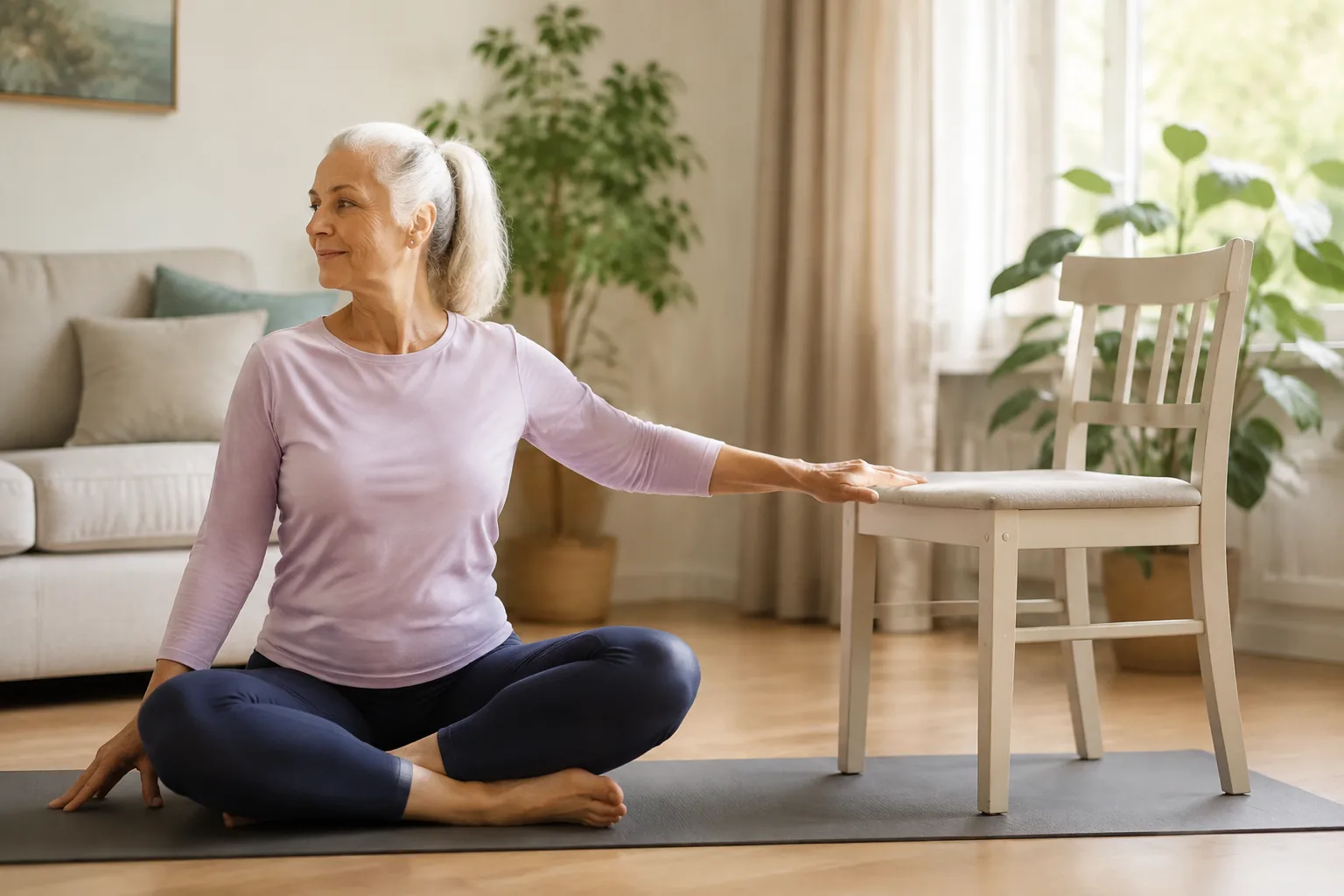
Bedtime yoga for sleep can serve as a consistent cue that the active part of the day is ending. The routine does not need to make you fall asleep on command. Its job is to lower stimulation, release comfortable ranges of tension and create a repeatable transition toward bed.
Evidence reviewed by the U.S. National Center for Complementary and Integrative Health suggests that yoga may support sleep for some groups, though results are not universal and persistent sleep problems may need professional assessment. Yoga should complement, not replace, care for insomnia, sleep apnoea, pain or mental health conditions.
This 15-minute evening yoga routine uses a bed, chair or floor. Keep breathing natural and avoid intense stretching or effort.
Prepare the environment
Dim bright overhead light if you can move safely. Silence nonessential notifications and set anything needed for morning before you begin. Use pillows and a blanket so the poses require less muscular work.
Do not worry about creating a perfect spa atmosphere. Consistency matters more than candles, music or special clothes.
A note about breathing
Gentle, unforced breathing is enough. If comfortable, let the exhale last a little longer than the inhale—for example, inhale for three counts and exhale for four. Do not hold the breath or force a large inhale.
Return to ordinary breathing if you feel dizzy, tingling, air hunger or anxiety. People with relevant medical or panic-related concerns should use individual guidance.
The 15-minute bedtime sequence
Minute 0–2: seated downshift
Sit on the edge of the bed or a chair with feet supported. Rest hands on thighs. Notice the weight of your feet and seat.
On each exhale, allow the shoulders and jaw to soften without forcing them. Keep eyes open or lower the gaze.
Minute 2–4: neck, shoulder and wrist release
Turn the head gently right and left three times. Tilt one ear slightly toward the same-side shoulder, return to centre and switch. Avoid pulling the head with your hand.
Circle shoulders slowly, then open and close the hands five times. Make small wrist circles if comfortable.
Minute 4–6: seated cat–cow and side reach
Place hands on thighs. Inhale and tip the pelvis forward slightly as the chest lifts. Exhale and tip it back as the upper back rounds. Repeat six times.
Then reach one arm upward and lean gently to the opposite side for two breaths. Change sides. Keep both sitting bones supported.
Minute 6–8: supported forward rest
Place pillows on your lap or on a table in front of the chair. Hinge forward and rest the torso and head on support. Keep enough height that breathing feels easy.
Stay for four to six breaths. If forward bending is uncomfortable or medically unsuitable, remain upright with back supported and hands resting.
Minute 8–10: reclined figure-four or seated option
Lie on the bed or floor with knees bent. Cross the right ankle over the left thigh. Stay there or gently draw the legs toward you. Hold for three breaths and switch.
For the chair option, place one ankle over the opposite shin or thigh and hinge slightly forward. Never push down on the knee.
Minute 10–12: supported twist
Lie with knees bent. Let both knees move a comfortable amount to the right and place pillows underneath them. Keep shoulders relaxed. Take three breaths, return through centre and change sides.
If twisting is unsuitable, skip it and place lower legs on a chair or pillows.
Minute 12–15: legs supported and quiet rest
Rest lower legs on a chair, pile of pillows or the bed headboard at a comfortable height. The hips do not need to be close to a wall. Alternatively, lie with knees bent and feet supported.
Notice five natural exhales. Let go of counting if it becomes work. End by rolling to one side or moving directly into your usual sleep position if you are already in bed.
A five-minute in-bed option
Complete:
- Shoulder release: one minute
- Seated cat–cow on the bed edge: one minute
- Reclined figure-four: one minute each side
- Knees supported by pillows: one minute
The short version is useful when fatigue is high or a longer routine would delay sleep.
Avoid making sleep another performance task
Sleep effort can become counterproductive. If you finish the routine and remain awake, the practice did not fail. It still created a quieter transition.
Avoid checking the time repeatedly or judging the night in advance. If lying awake becomes frustrating, follow evidence-based guidance from your clinician or a trusted sleep resource rather than adding more and more relaxation techniques.
Pair yoga with practical sleep hygiene
Bedtime yoga works best inside a broader routine:
- keep wake time reasonably consistent;
- get daylight and activity during the day;
- manage caffeine timing;
- make the bedroom dark, quiet and comfortable;
- reduce stimulating work immediately before bed; and
- use the bed primarily for sleep where appropriate.
Our sleep hygiene tips guide explains how to build a routine that fits real schedules.
When to practise
Try the sequence 30 to 60 minutes before your intended sleep time, or immediately before bed if that is easier. Use it on three or four nights for two weeks before judging it.
Some people feel more alert after movement. If that happens, practise earlier or use only the supported rest and breathing portions.
Common modifications
Knee discomfort
Keep joints supported with pillows and avoid kneeling. Use the chair for all movements.
Reflux
Avoid lying flat or folding forward soon after eating if those positions worsen symptoms. Stay upright and follow medical advice.
Pregnancy
Position needs change across pregnancy. Avoid generic advice about lying positions or deep twists and seek prenatal guidance from an appropriately qualified professional.
Glaucoma or blood-pressure concerns
Some inverted or head-down positions may be unsuitable. This routine can be kept upright, but confirm relevant restrictions with your clinician.
Trauma or anxiety
Closed eyes, stillness and certain positions may feel unsafe. Keep eyes open, face the room, sit near an exit and choose external anchors. A trauma-informed teacher can help adapt the practice.
When sleep problems need assessment
Seek professional advice if sleep difficulty persists, causes significant daytime impairment or involves loud snoring, gasping, breathing pauses, restless legs, unusual behaviours, severe mood symptoms or safety concerns. Cognitive behavioural therapy for insomnia is an evidence-based treatment that a relaxation routine does not replace.
Do not drive or operate machinery when dangerously sleepy. In an emergency or mental health crisis, use local urgent support.
How bedtime yoga fits in the yoga cluster
This is an evening wind-down. For a daytime practice, explore our yoga for beginners guide; for gentle movement that also supports stress management, see our mental wellbeing guide. Use the version that fits the time of day and your current energy.
Frequently asked questions
Do I need to practise every night?
No. Begin with three or four nights for two weeks. A repeatable cue matters more than a perfect streak. On other nights, use the five-minute version or keep another consistent wind-down.
Can yoga compensate for too little sleep?
No. Relaxation may help you prepare for sleep, but it does not replace sufficient sleep opportunity. Protect time in bed and address work, caregiving or health barriers where possible.
Should I use a sleep-tracking watch during the routine?
Only if it stays in the background. A wearable can show broad timing trends, but watching the score closely may increase sleep anxiety. Hide the score or stop overnight tracking if it makes you monitor rather than rest.
What if a stretch wakes me up?
Use less range, shorter holds and more support, or skip stretching entirely. Try seated breathing and quiet rest. The routine should reduce effort as it progresses.
Is “legs up the wall” required?
No. It may be uncomfortable or unsuitable for some people. Lower legs on a chair, knees over pillows or simple side-lying rest can provide support without an inversion.
Keep a low-pressure two-week note
Record the practice time, approximate lights-out time and how you felt the next day. Do not grade individual nights. Look for whether the routine was easy to repeat and whether it reduced pre-bed stimulation. If tracking increases worry, stop recording and keep only the routine.
The bottom line
Bedtime yoga for sleep is a quiet cue, not a sedative you must make work. Use supported poses, unforced breathing and a repeatable 15-minute order. Combine it with practical sleep habits and seek care when sleep problems persist.
A gentle routine can close the day even when sleep arrives on its own schedule.
If one pose consistently feels especially comfortable, let it become your reliable final cue. Familiarity can be more settling than adding new techniques, and a simple supported position is often easier to maintain than an elaborate sequence.
Further reading
Related guides
- Yoga for beginners guide
- Mental wellbeing and stress management
- Healthy habits guide
- Gentle yoga for seniors
- Healthy ageing exercise guide
Continue with these guides
- Chair Pilates for Seniors: Gentle Strength and Mobility
- Nutrition for Cognitive Health: Food Habits for Healthy Ageing
A note on this post: I’m Ben Shannon, the person behind Healthful Harbor. I’m not a doctor, dietitian, physiotherapist, psychologist or any other kind of clinician. I’m a regular person who reads research, tries things, and writes about what’s worked for me. Everything on this site is general educational information, not individual medical, nutrition or mental-health advice. For your own situation, please talk with a qualified professional who knows your circumstances. See the Health Information Disclaimer for the full picture.