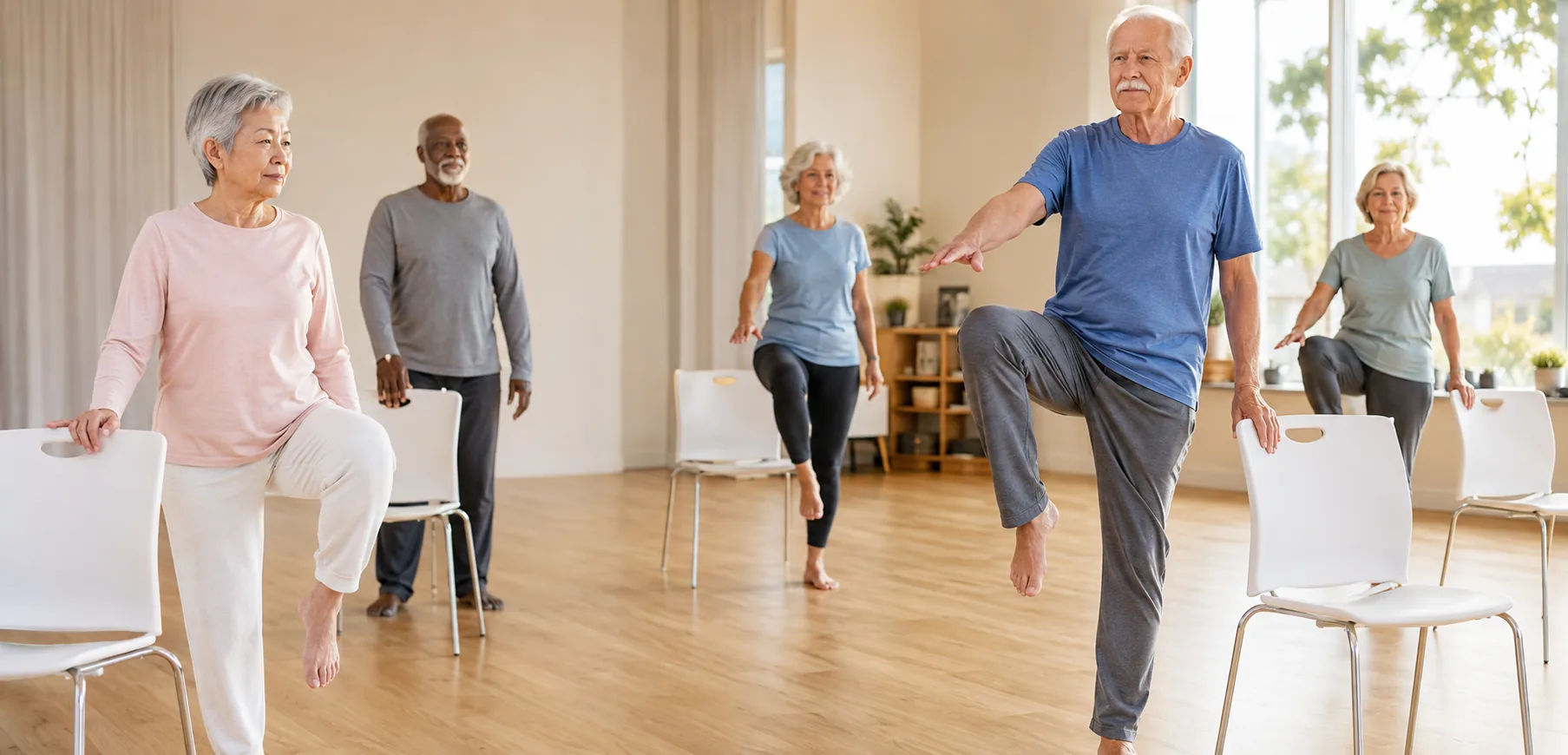
Kitchen bench balance exercises for beginners are a practical way to add stability practice to your day without buying equipment. A sturdy, clear bench gives you a nearby support while you learn to shift weight, stand on one leg briefly, and move with more awareness.
Balance is not something you either have or do not have. It is a skill that responds to regular, safe practice. The goal is not to balance without support on day one. The goal is to stay close to a firm surface, choose a manageable challenge, and build confidence one small step at a time.
If you are new to a regular routine, begin with the healthy ageing exercise guide. It shows how strength, balance, mobility, and recovery can work together instead of competing for your time.
Why use the kitchen bench?
The kitchen bench is convenient, waist-high for many people, and easy to reach. It can provide fingertip support while you practise. Unlike holding a wobbly chair, placing both hands lightly on a fixed bench can help you feel grounded.
Clear the floor first. Move rugs, pet bowls, bags, and loose cords. Wear shoes with a secure sole, or practise barefoot only if your flooring is dry and non-slip. Keep the bench free of hot drinks, sharp objects, and clutter. A support is there for safety, not as something to pull on.
Who should get individual guidance first?
Talk with a clinician or physiotherapist before starting if you have had a recent fall, fainting episodes, sudden changes in balance, severe dizziness, new weakness, or a recent surgery or fracture. Stop immediately if you feel chest pain, severe shortness of breath, faint, or develop pain that feels sharp or worsening.
For everyone else, begin with both hands on the bench. The smallest safe version still counts. A good balance session leaves you feeling more aware, not shaken or exhausted.
The balance principles that make practice safer
- Keep support close. Start with both hands, then one hand, then fingertips only if you are steady.
- Use your eyes. Look at a still point on the wall rather than down at your feet.
- Move slowly. Slow weight shifts teach your body more than quick, rushed repetitions.
- Choose an easy breath. If you cannot breathe normally, the task is too demanding.
- Change one thing at a time. Do not narrow your stance, close your eyes, and remove your hands all at once.
Warm up: two minutes of gentle movement
Stand facing the bench with both hands resting lightly on it. March gently in place for 30 to 60 seconds. Then do 8 slow heel raises: lift both heels, pause, and lower. Finish with 6 easy shoulder rolls and 6 ankle circles per side. The warm-up is simply a way to notice how your body feels today.
Five kitchen-bench balance exercises for beginners
1. Side-to-side weight shift
Stand with feet hip-width apart and hands on the bench. Slowly shift a little more weight into your right foot without lifting the left. Return to centre, then shift left. Keep your hips level and your shoulders relaxed. Do 8 shifts each way.
This teaches you to notice your base of support. It is especially useful if you feel unsteady during turns or when stepping around furniture.
2. Forward-and-back weight shift
Keep both hands on the bench. Gently move a little weight toward the balls of your feet without lifting your heels. Return to centre, then move a little weight toward your heels without lifting your toes. The movement is small. Do 8 slow repetitions.
Think of your feet as a tripod: heel, base of big toe, and base of little toe all stay in contact with the floor.
3. Supported heel-to-toe stance
Place one foot a short step in front of the other, as though you are standing on a narrow path. Keep a comfortable gap between your feet at first; they do not need to touch. Hold the bench with both hands and stay for 10 to 20 seconds. Switch sides and repeat twice.
As it becomes easier, reduce the gap slightly or rest one hand more lightly. Keep your normal breath going.
4. Supported single-leg stand
With both hands on the bench, shift weight into one foot and lightly lift the other heel or toes from the floor. You do not need to raise the whole foot high. Hold for 5 to 10 seconds, then switch. Repeat three times each side.
A toe can remain on the floor like a kickstand. That is a smart modification, especially at the beginning.
5. Slow standing march
Stand tall, hands on the bench. Lift one knee a comfortable amount, lower it slowly, then switch sides. Aim for 6 to 10 controlled lifts each side. Pause between repetitions if needed.
Slow marching adds a small movement challenge while you stay close to support. It can also help you practise lifting your feet rather than shuffling.
Your 10-minute kitchen-bench routine
- Warm up for two minutes.
- Do side-to-side shifts for one minute.
- Do forward-and-back shifts for one minute.
- Practise the supported heel-to-toe stance for two minutes, alternating sides.
- Practise supported single-leg stands for two minutes.
- Finish with slow marching for one minute, then take a relaxed one-minute walk around the room.
Try it two or three times a week. On days when you feel tired, do only the warm-up and one exercise. Keeping the habit easy enough to repeat is the real win.
Ways to progress safely
First, improve control. Hold the same position for a few more seconds while keeping your grip light. Next, reduce from two hands to one hand. Later, rest just fingertips on the bench. You might narrow your foot position only after those steps feel steady.
Do not practise with closed eyes, on a cushion, or while multitasking unless a qualified professional has recommended it for you. Those changes can increase fall risk without adding useful confidence for a beginner.
Common mistakes to avoid
Gripping the bench tightly: keep enough contact to feel safe, but do not hang from it. A light grip lets your legs and feet contribute.
Holding your breath: exhale slowly as you shift or lift. A relaxed breath often reduces unnecessary tension.
Chasing a long hold: five calm seconds is more useful than twenty shaky ones.
Practising when dizzy or unwell: take a seated rest or skip the session. Balance practice should not be a test of willpower.
Build the strength that supports balance
Balance is easier when your legs and hips are also getting stronger. Add a few chair squats for beginners over 50 on two days each week, using a stable chair and a comfortable range. Our fall-prevention fitness guide has further ideas for combining strength and balance at home.
Walking is useful too, especially when it is comfortable and suited to your current energy. See our walking on rest days guide for other gentle ways to build activity gradually. For a broader starting plan, return to the beginner fitness guide.
Frequently asked questions
How often should beginners do balance exercises?
Short practice sessions two or three times a week are a reasonable start for many people. Brief, regular practice is often more helpful than one long, fatiguing session.
Can I use a kitchen chair instead?
A heavy, stable chair backed against a wall can work, but a fixed bench is usually more secure. Never use a chair with wheels.
What if one side is much harder?
That is common. Give the less-steady side a little extra time, keep the support generous, and avoid forcing it. If the difference is new or marked, discuss it with a health professional.
Make balance practice part of normal life
Short sessions work best when they are attached to an existing cue. You might do the routine after putting on the kettle, before lunch, or after clearing the evening dishes. Keep it brief enough that you are willing to repeat it. Mark the days you practise on a calendar; seeing a small run of sessions can be more motivating than testing your balance every day.
Balance can vary with sleep, medication changes, vision, hydration, and stress. A day that feels less steady is a signal to use more support, not to give up. Return to two hands on the bench whenever you need to. That is good self-management.
Next step
Clear a small space at your kitchen bench and do one round of side-to-side weight shifts today. Start where you feel secure. The routine can grow from there.