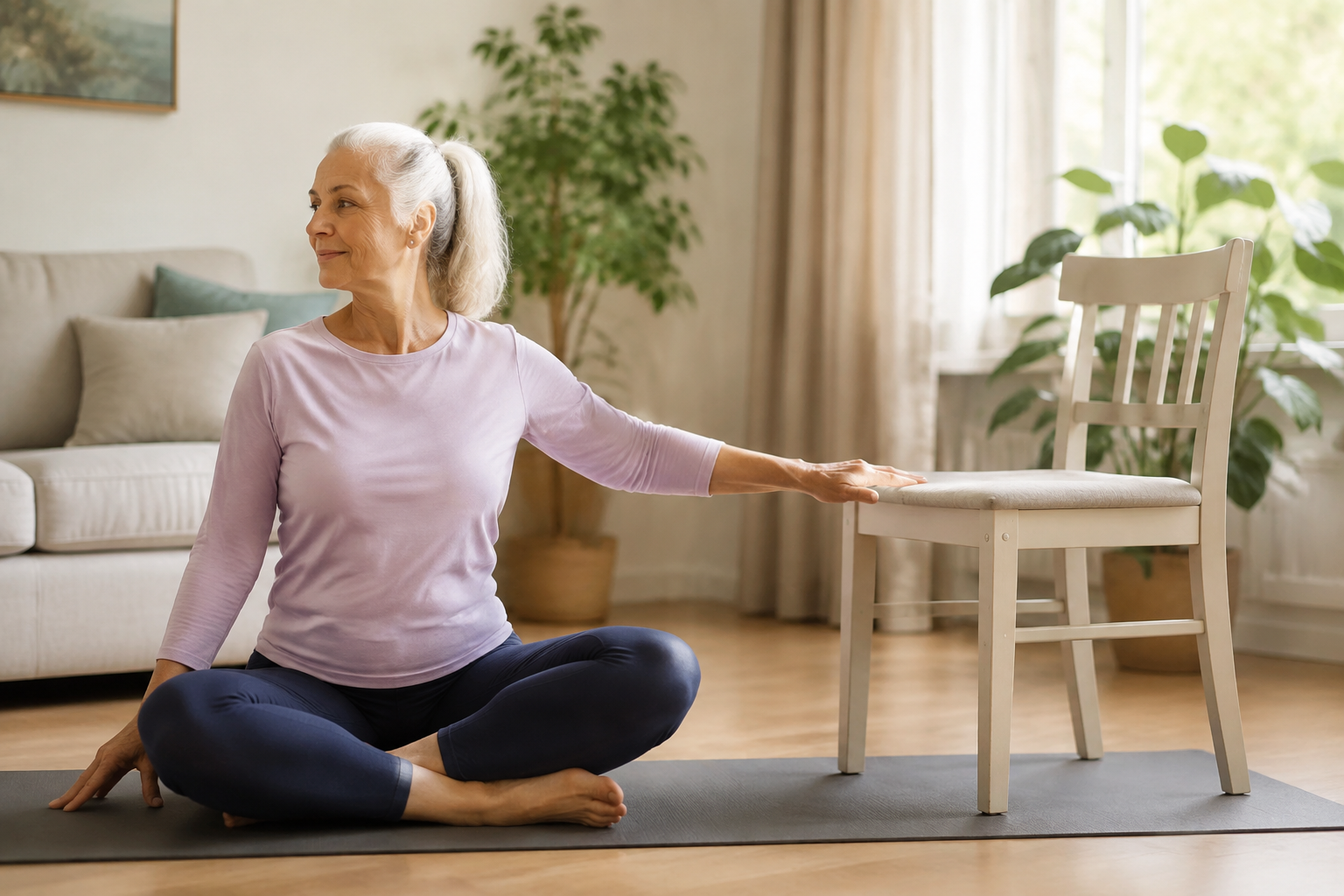
Yoga for stress relief does not require extreme flexibility or a silent mind. A simple practice can combine comfortable movement, steady attention and unforced breathing to create a transition out of a demanding day.
Research reviewed by the U.S. National Center for Complementary and Integrative Health suggests that yoga may support stress management and general wellbeing, although results vary and yoga is not a replacement for mental health or medical care. The useful beginner question is not “Did I perform every pose perfectly?” but “Did this practice leave me a little more settled and connected to my body?”
This 20-minute sequence uses calming yoga poses with accessible options. Move in a pain-free range, breathe normally and skip anything that feels unsafe. If you are pregnant, have glaucoma, uncontrolled blood pressure, significant osteoporosis, a recent injury or another relevant condition, ask a qualified professional which poses and breathing practices suit you.
Set up a low-pressure practice
Use a mat or non-slip surface, a sturdy chair, a folded blanket and two cushions or firm pillows. Wear clothing that allows easy movement. Reduce distractions, but do not wait for ideal conditions.
Decide in advance that you may:
- use the chair;
- keep knees bent;
- make the range smaller;
- rest at any time;
- breathe naturally; and
- finish early.
These are not lesser versions. They are how you match the practice to your body today.
How to breathe
Let the breath remain quiet and comfortable. If it feels pleasant, allow the exhale to become slightly longer than the inhale without holding. For example, inhale for about three counts and exhale for four.
Stop controlled breathing if it causes dizziness, tingling, air hunger or more anxiety. Return to normal breathing and focus on an external anchor such as the feel of the floor. People with respiratory, cardiovascular or panic-related concerns may need individual guidance.
The 20-minute beginner sequence
Minute 0–2: seated arrival
Sit on a chair with feet supported or sit comfortably on a folded blanket. Rest hands on thighs. Notice three points of contact: feet, seat and hands.
Look around the room and name three neutral objects. Then notice the breath without changing it. This external-to-internal transition can feel gentler than demanding instant stillness.
Minute 2–4: shoulder and upper-back movement
Inhale and lift the shoulders slightly; exhale and let them drop. Repeat five times.
Place hands across the chest or on opposite shoulders. Turn the upper body a small amount to the right, return to centre and turn left. Keep the movement slow and comfortable for six rounds.
Reach arms forward and gently round the upper back, then open the arms and chest without forcing. Repeat five times.
Minute 4–6: seated cat–cow
Place hands on thighs. As you inhale, tip the pelvis slightly forward and lift the chest. As you exhale, tip the pelvis back and allow the upper back to round. Move through a small, smooth range for six to eight repetitions.
Keep the neck easy. The movement follows the breath, but you can breathe normally if coordination feels stressful.
Minute 6–8: supported standing side stretch
Stand beside the chair with feet comfortable. Hold the chair lightly with the right hand. Reach the left arm upward and lean a small amount to the right, keeping both feet grounded. Take two or three breaths, then change sides.
Think of creating length rather than collapsing sideways. Keep the raised arm lower if shoulder movement is limited.
Minute 8–10: half sun-flow at a chair
Face the chair. Inhale and reach arms forward or overhead. Exhale, bend the knees and hinge at the hips, placing hands on the chair seat or back. Inhale, lengthen the spine into a comfortable halfway position. Exhale and return upright.
Repeat four to six times. Move slowly enough that you do not become light-headed. Keep your head above your heart if bending forward causes symptoms or is medically unsuitable.
Minute 10–12: supported low lunge
Hold the chair and step the right foot back into a short stance. Keep the back heel lifted or place it down at an angle. Bend the front knee slightly until you feel a gentle opening at the front of the back hip. Keep the torso upright.
Take three breaths, step in and change sides. Shorten the stance if balance feels uncertain.
Minute 12–14: wide-knee child’s pose or chair rest
Floor option: Kneel on padding, bring knees apart comfortably and hips toward heels. Rest your torso on stacked cushions so the body is supported. Keep hips higher if knees object.
Chair option: Sit and place forearms on a table or on pillows in your lap. Let the head rest if comfortable.
Stay for five to eight breaths. There is no need to reach deeply.
Minute 14–16: reclined figure-four or seated hip stretch
Floor option: Lie on your back with knees bent. Cross the right ankle over the left thigh. Stay there or draw the legs toward you without lifting the head. Hold for three to five breaths and switch.
Chair option: Sit tall and place one ankle over the opposite shin or thigh. Hinge forward slightly only if the knee and hip are comfortable.
Avoid pushing on the raised knee.
Minute 16–18: supported twist
Lie on your back with knees bent and feet down. Let both knees move a small amount to one side while shoulders remain comfortable. Place a pillow under the knees so they are supported. Take three breaths and change sides.
Alternatively, sit sideways on a chair and rotate gently toward the chair back. Keep the twist through a comfortable range and avoid pulling aggressively.
Minute 18–20: constructive rest
Lie on your back with lower legs on the chair seat, or keep knees bent and feet down. If lying down is unsuitable, sit supported.
Let breathing return to normal. Notice the weight of the body and the support underneath it. When ready, roll to one side before sitting up, or rise slowly from the chair.
A five-minute version
On a busy day, complete:
- Seated arrival: one minute
- Seated cat–cow: one minute
- Chair half-flow: one minute
- Supported child’s pose or chair rest: one minute
- Constructive rest: one minute
Short practices can strengthen the cue that yoga is available without requiring a perfect window.
Make the sequence more calming
Reduce decision-making
Use the same order for two weeks. Familiarity can lower cognitive load and help you notice how your body feels.
Choose comfortable sensory input
Dim light if safe, adjust temperature and use music only if it helps. Some people settle better with silence; others prefer a consistent sound.
Finish before checking your phone
Give yourself one minute after the final pose before opening messages. The transition helps preserve the change of pace.
Avoid turning flexibility into the goal
Stress relief does not require a deeper stretch. Choose enough sensation to hold your attention while breathing remains easy.
Common beginner concerns
“My mind keeps wandering”
Wandering is normal. Each time you notice it, return to a concrete anchor: the contact of your foot, the next movement or a sound. Returning is the practice.
“I cannot breathe slowly”
Do not force it. Breathe naturally and move at your own pace. You can focus on smooth movement rather than breath length.
“A pose makes me anxious”
Leave the pose, sit up and orient to the room. Some positions, closed eyes or breath control can feel unsafe for personal reasons. Choose eyes-open, chair-based options and seek trauma-informed instruction if helpful.
“I feel pain in my knees or wrists”
Use a chair and remove weight-bearing through the uncomfortable joint. More padding is not always the solution; a different pose may be better. Persistent or significant pain deserves assessment.
Where yoga fits in a wellbeing plan
Yoga can complement walking, strength work, sleep routines, social connection and professional care. It does not need to replace cardio or progressive strength training.
Try this weekly rhythm:
- two full-body strength sessions;
- two or three walks or other aerobic sessions;
- this calming sequence once or twice; and
- the five-minute version when it is useful.
For another short practice, use the 10-minute morning yoga routine. For evening cues, try bedtime yoga for sleep. The mental wellbeing guide places yoga among a wider set of supports.
When to seek more support
Yoga may be a supportive activity, but persistent anxiety, low mood, trauma symptoms or loss of function deserve professional care. If you are in crisis or may harm yourself, contact local emergency or crisis services now. In Australia, Lifeline is available on 13 11 14 and emergency help on 000.
Tell a yoga teacher about relevant injuries or conditions before class and ask what training they have for your needs. A good teacher offers choices and respects a decision to stop.
The bottom line
Yoga for stress relief works best as a comfortable, repeatable practice rather than a test of flexibility. Use support, keep breathing unforced and choose poses that let your nervous system feel safe enough to settle.
Twenty minutes is useful; five minutes is still a complete practice. The aim is not to remove every thought, but to create a kinder place to meet the next one.
Further reading
Further reading
For practical guidance on managing stress, see Healthdirect Australia: Stress.
Further reading
For practical guidance on managing stress, see Healthdirect Australia: Stress.